News
Urban areas face a difficult water-management challenge. During heavy rainfall, rivers and drainage channels may need to move large volumes of water through densely developed districts. During dry periods, however, the same waterways may have insufficient depth for water storage, landscape enhancement, groundwater recharge, or recreational use.
Traditional fixed weirs can maintain an upstream water level, but they cannot easily adapt to changing flow conditions. Large steel-gate systems offer greater control, yet they may require substantial civil works, operating space, mechanical equipment, and maintenance.
Water hydraulic dams provide a more flexible alternative for suitable low-head water-control projects. By raising or lowering an inflatable barrier, operators can adjust water levels according to rainfall, river discharge, seasonal demand, and urban flood-management requirements.
The term water hydraulic dam commonly refers to a water-filled inflatable rubber dam, also known as a hydraulic rubber dam, inflatable weir, bladder dam, or flexible membrane dam.
The main barrier consists of a reinforced rubberized fabric membrane anchored to a concrete sill across a river, canal, spillway, or drainage channel. Water is pumped into the membrane to inflate it and raise the upstream water level. When higher discharge capacity is required, the water is released and the membrane lowers onto the foundation.
Engineering guidance describes inflatable dams as rubberized fabric structures anchored to a sill and inflated to create a low-head barrier. Their principal components normally include the dam membrane, anchoring system, foundation, filling and drainage pipes, pumps, valves, sensors, and control equipment.
Because the dam height can be changed instead of remaining fixed, the system can respond to different river conditions throughout the year.
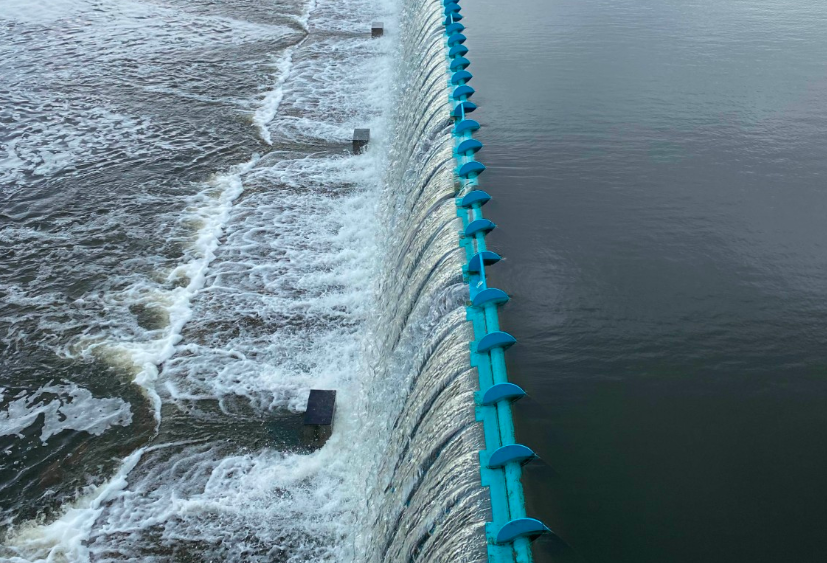
A typical operating cycle includes three conditions.
Water is pumped into the rubber membrane until it reaches the designed height and internal pressure. The raised barrier retains water upstream, forming a controlled pool or increasing the depth of an existing river or canal.
This position may be used for:
· Maintaining an urban landscape water level
· Diverting water into treatment or irrigation facilities
· Supporting groundwater recharge
· Increasing navigation or intake depth
· Creating a recreational water area
Operators can reduce the internal water volume to lower the crest. This allows more water to pass while maintaining a selected upstream level.
Partial adjustment can be useful when river discharge changes gradually or when the project requires more precise level control.
Before a major storm or during high river flow, the membrane can be lowered onto its foundation. This restores much of the channel’s discharge area and allows floodwater, sediment, and floating debris to pass downstream.
The ability to move between these positions is the main reason water hydraulic dams are considered for urban waterways with highly variable conditions.
One of the most important benefits of a water hydraulic dam is its ability to respond to changing flow conditions.
A fixed weir continues to obstruct the channel during both low-flow and high-flow periods. An inflatable dam can remain raised when water retention is beneficial and be lowered when additional discharge capacity is required.
Before forecast heavy rainfall, operators may deflate the dam to reduce the upstream water level and prepare the channel for incoming runoff. During high flows, lowering the barrier can help avoid unnecessary upstream backwater effects.
This does not mean that an inflatable dam can eliminate urban flooding by itself. Flood risk depends on rainfall intensity, upstream catchment conditions, channel capacity, drainage networks, downstream water levels, and operating procedures. However, an adjustable barrier gives water managers an additional level of operational control that a fixed structure cannot provide.
Inflatable dams are therefore most effective when integrated with:
· Urban drainage systems
· Retention and detention basins
· Floodwalls and levees
· Forecasting and warning systems
· River-channel improvements
· Emergency operating procedures
Urban waterways often need to serve several functions at the same time. A river may support stormwater drainage, public parks, water intakes, wildlife habitat, groundwater recharge, and visual landscape development.
These functions may require different water levels at different times.
By controlling the amount of water inside the dam membrane, operators can adjust the crest height and regulate the upstream pool more accurately than with a conventional fixed-crest weir.
Stable water levels may benefit:
· Municipal water-intake structures
· Riverside parks and walkways
· Landscape lakes and urban wetlands
· Small navigation channels
· Industrial water systems
· Recreational boating areas
· Riverfront development projects
This flexibility is particularly valuable in rivers where the natural water level changes substantially between wet and dry seasons.
Traditional flashboards may need to be installed or removed manually. That process can require workers and heavy equipment to enter the river area before or after a storm.
A water hydraulic dam can instead be connected to pumps, valves, water-level sensors, rainfall monitoring systems, and a programmable control panel. Depending on the project design, the dam may be operated locally, remotely, or automatically.
A FERC environmental assessment for a California water-management project noted that replacing an existing flashboard structure with an inflatable rubber dam would allow more rapid management of the upstream percolation pond.
Faster operation can help municipalities:
· Prepare the channel before peak runoff arrives
· Adjust water levels without placing workers in dangerous flows
· Respond to unexpected upstream discharge
· Restore the normal pool after a storm
· Coordinate dam operation with downstream infrastructure
Automatic operation must still include suitable alarms, backup power, manual controls, and emergency procedures.
Cities rarely have unlimited land available for new hydraulic infrastructure. Rivers may pass between roads, buildings, railways, utility corridors, parks, and residential districts.
Large gate structures can require piers, lifting machinery, overhead frames, access platforms, and substantial operating rooms. A hydraulic rubber dam has a comparatively low visual and structural profile.
When deflated, the membrane lies close to the riverbed foundation rather than remaining as a large permanent obstruction. This can make the technology attractive for locations where planners want to preserve views or reduce the visual impact of water-control infrastructure.
Its compact configuration may be suitable for:
· Narrow urban river channels
· Existing concrete weirs
· Drainage canals
· Park waterways
· Water-treatment intake channels
· Overflow structures
· Urban redevelopment projects
Suitability still depends on hydraulic modelling, foundation conditions, channel geometry, debris loads, and access for maintenance.
Constructing a major concrete dam or complex steel-gate structure in an urban district can interrupt traffic, utilities, businesses, pedestrian routes, and nearby communities.
Inflatable dams still require professional civil construction, including a foundation, anchoring system, control room, pipework, electrical equipment, and channel protection. Nevertheless, the superstructure is generally simpler than many conventional movable-gate systems.
For appropriate low-head projects, this may reduce:
· The quantity of large structural components
· The need for high overhead lifting equipment
· Construction time within the active channel
· Long-term visual impact
· Interference with surrounding urban development
The actual cost and construction period must be evaluated project by project. Channel diversion, cofferdams, environmental protection, fish rescue, utility relocation, and contaminated sediment can still be major cost factors in urban installations.
Groundwater is an important source of municipal, industrial, and emergency water supply in many cities. Urban development, however, covers natural soil with roads, roofs, and other impermeable surfaces, reducing infiltration.
A water hydraulic dam can raise the level of a river or recharge basin so that water remains in contact with permeable soil for a longer period. This can support managed aquifer recharge where geology, water quality, and local regulations permit it.
Inflatable dams may be installed at:
· River recharge zones
· Percolation ponds
· Seasonal channels
· Managed aquifer recharge facilities
· Stormwater capture projects
The proposed Coyote Creek bladder-dam project described by FERC, for example, was connected with management of a percolation pond whose primary purpose was groundwater recharge.
Recharge projects require careful water-quality monitoring. Retaining polluted urban runoff without adequate treatment could create water-quality problems rather than solve them.
Many urban rivers experience low flows during dry seasons. Without a control structure, water may become too shallow for municipal intakes, landscape objectives, habitat pools, or recreational activities.
Inflating a hydraulic dam can retain available flow and create a deeper upstream pool without requiring a tall permanent structure.
Stored water may support:
· Municipal non-potable water uses
· Landscape irrigation
· Industrial water intake
· Firefighting reserves
· Wetland maintenance
· Downstream flow management
· Drought-response planning
A hydraulic dam does not create new water. It changes when and where available water is retained. Authorities must therefore consider downstream water rights, ecological flow requirements, evaporation, sedimentation, and seasonal operating restrictions.
Urban waterways are increasingly treated as public spaces rather than simply as drainage channels. Cities are developing riverfront parks, pedestrian areas, cultural districts, greenways, and recreational corridors.
Maintaining a controlled upstream water level can improve the appearance of a river during low-flow periods. A deeper, more consistent pool may support boating, waterfront events, landscape fountains, or reflective water features.
This can contribute to:
· More attractive public spaces
· Increased riverfront use
· Improved connections between neighborhoods
· New tourism and recreation opportunities
· Greater commercial activity near the waterfront
However, visual improvement should not be achieved at the expense of water quality. A slow-moving urban pool can experience algae, odor, low dissolved oxygen, or floating-waste accumulation. Aeration, circulation, pollutant control, and periodic flushing may therefore be required.
Sediment accumulation reduces channel capacity and can interfere with water intakes, pumps, and river habitats.
When an inflatable dam is lowered, higher flows can pass through the channel with fewer structural obstructions. This may help transport some accumulated sediment and floating material downstream.
Deflation can also reduce the risk of large flood-borne debris striking an elevated barrier. FERC guidance notes that the membrane lies flat on its foundation when deflated, allowing it to move out of the way of heavy debris, although debris can still land on and damage the tube.
Effective debris management may require:
· Upstream trash racks or booms
· Regular river inspections
· Controlled flushing schedules
· Scour protection
· Sediment surveys
· Cleaning access
· Membrane-protection measures
Simply deflating the dam does not guarantee that all sediment will be removed. The result depends on flow velocity, sediment type, channel slope, downstream conditions, and operating duration.
Compared with a permanently raised barrier, a deflatable dam can offer greater operational flexibility for managing river connectivity.
During selected periods, lowering the membrane may create a less obstructed channel for sediment movement and aquatic passage. Fish ladders or bypass channels can also be incorporated where necessary.
Environmental benefits may include:
· Seasonal restoration of a more open channel
· Greater control over upstream water levels
· Support for urban wetlands
· Improved management of habitat pools
· Reduced permanent visual obstruction
· Coordination with ecological-flow releases
These benefits are not automatic. Fish movement over a deflated membrane, for example, depends on foundation shape, downstream water depth, flow velocity, surface condition, and species requirements. The FERC review of the Coyote Creek project included specific downstream modifications and fish-passage planning rather than assuming that deflation alone would provide suitable passage.
Environmental agencies and aquatic specialists should therefore participate early in the design process.
Modern water hydraulic dams can be connected to digital monitoring and control platforms.
Common monitoring points include:
· Upstream and downstream water levels
· Internal membrane pressure
· Pump and valve status
· Rainfall
· River discharge
· Water quality
· Equipment-room conditions
· Power-supply status
The control system can alert operators when water levels exceed a threshold, pressure falls unexpectedly, a pump fails, or a storm requires a change in operating mode.
Data collected over time can also help authorities improve:
· Seasonal operating rules
· Flood-response planning
· Maintenance scheduling
· Water-allocation decisions
· River modelling
· Emergency coordination
Automatic controls should always be supported by cybersecurity measures, manual override capability, redundant sensors, and backup power.
Inflatable dams have fewer large moving metal components than many gate systems. The membrane and associated pumping equipment can usually be inspected using a planned maintenance program.
Typical maintenance activities include:
· Inspecting the membrane for cuts and abrasion
· Checking anchor bolts and clamping plates
· Testing pumps and valves
· Cleaning pipes and filters
· Calibrating pressure and level sensors
· Inspecting the foundation for scour
· Testing backup power
· Removing accumulated debris
· Performing trial inflation and deflation
FERC guidance indicates that minor membrane damage may be repairable with plug or patch methods, although larger damage generally requires the membrane to be deflated and the work area dried.
Maintenance requirements should be assessed over the complete design life rather than focusing only on the initial installation cost.
Water hydraulic dams are generally considered for adjustable, low-head water-control applications rather than very high dams or major reservoir structures.
Potential urban applications include:
· River-level regulation
· Flood-channel management
· Groundwater recharge
· Municipal water diversion
· Urban landscape lakes
· Stormwater retention
· Small hydropower intakes
· Wastewater or industrial water channels
· Recreation and navigation pools
· Existing weir modernization
USACE guidance characterizes inflatable rubber dams as structures used for very low-head projects and highlights their vulnerability to puncture and vandalism, showing why correct application selection is essential.
Before selecting a hydraulic rubber dam, project owners should conduct a complete feasibility assessment.
Engineers must evaluate normal flow, minimum flow, design floods, upstream backwater, downstream water level, overflow depth, flow velocity, and channel capacity.
The concrete sill and foundation must resist sliding, seepage, uplift, settlement, and scour. FERC guidance also recommends considering flow alignment and avoiding unsuitable bends in the immediate dam location.
Urban rivers may carry branches, construction waste, metal objects, and household trash. Public access can also increase vandalism risk. Protective materials, surveillance, barriers, and debris-management systems may be necessary.
The membrane should be selected for tensile strength, watertightness, abrasion resistance, temperature range, weathering, and ozone exposure. EPDM- and chloroprene-based materials are among the options referenced in engineering guidance.
The filling and drainage system must remain functional during severe weather. The design should include redundant pumps or valves where required, backup power, overpressure protection, emergency deflation, alarms, and manual operation.
Permits may address fish passage, minimum downstream flows, sediment release, water rights, construction dewatering, water quality, cultural resources, and public safety.
Water hydraulic dams offer cities a flexible way to control low-head water levels without relying solely on a permanent fixed barrier. Their ability to inflate, partially lower, or fully deflate allows the same structure to support water retention during dry periods and increased channel capacity during high flows.
For appropriate sites, the benefits can include more responsive flood management, stable urban river levels, groundwater recharge, improved riverfront use, reduced visual impact, and integration with automated water-control systems.
However, successful installation depends on much more than the dam membrane itself. Hydraulic modelling, foundation design, debris protection, environmental planning, reliable controls, maintenance access, and emergency operating procedures are all essential.
When these factors are properly addressed, an inflatable water hydraulic dam can become a valuable part of a broader urban water-management strategy—helping cities balance flood resilience, water conservation, environmental needs, and public use of their waterways.
A water hydraulic dam uses water to inflate the flexible membrane, while a pneumatic rubber dam uses air. Water-filled systems are generally heavier and may provide stable operation under certain flow conditions, while air-filled systems can often inflate and deflate more quickly. Project engineers should compare operating speed, vibration, power requirements, climate, dam dimensions, and maintenance needs.
It can support flood-risk management by lowering before or during high flows and increasing the available channel opening. It cannot independently prevent every flood. Performance depends on the capacity of the entire river and drainage system.
They are mainly used for low-head water-level control, diversion, recharge, and river-management projects. They are not normally treated as substitutes for major high-head storage dams.
Service life depends on membrane construction, operating frequency, ultraviolet exposure, sediment abrasion, debris, water chemistry, maintenance, and local climate. Buyers should evaluate material specifications, design life, inspection requirements, repair methods, and replacement planning with the system supplier.
Yes. Pumps and valves can be controlled using water-level sensors, pressure sensors, rainfall information, flow measurements, and programmable control systems. Critical projects should also include manual controls, alarms, backup power, and emergency procedures.