News
Water is essential to life — we all understand its importance. However, managing water flow in rivers is a complex challenge. We need to conserve water when possible and release excess flow safely during high-water conditions. For many years, traditional water control relied on large, heavy gates made from concrete and steel. While these structures are effective, they are often expensive to construct and difficult to operate or relocate. Today, a smarter and more flexible solution is changing the way we manage rivers: the rubber dam.
At BIC, we see the advantages of this simple yet innovative technology every day. As a leading rubber dam manufacturer in China, we understand that river management does not always require complicated structures. With the right solution, water control can be efficient, environmentally friendly, and easier to maintain. In this article, we will explore how rubber dams work and why they are becoming an increasingly important choice for modern water management.
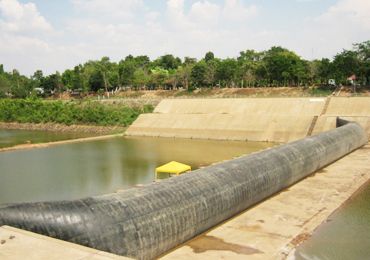
Let us begin with the basics. What is a rubber dam in a river? The simplest way to imagine it is as a large, durable inflatable barrier installed across a riverbed. Unlike traditional concrete structures, a rubber dam is not a permanent rigid wall. Instead, it is a strong fabric tube or bladder securely fixed to a concrete foundation at the bottom of the river.
When the tube is deflated, it lies flat along the riverbed, allowing water to flow over it naturally. When water control is needed, the tube is inflated with air or water. As it expands, the rubber dam rises and forms a temporary barrier. This helps retain water, regulate flow, and increase the upstream water level. The concept is simple, but the results make it a highly effective tool for modern water storage and control.
The material used for rubber dams is specially designed for long-term outdoor and underwater performance. It typically consists of a high-strength fabric, such as nylon or polyester, coated with durable, weather-resistant synthetic rubber. This structure provides the strength needed to withstand sunlight, floods, and changing water conditions while maintaining flexibility. This combination of durability and adaptability is what makes rubber dams an impressive advancement in water engineering.
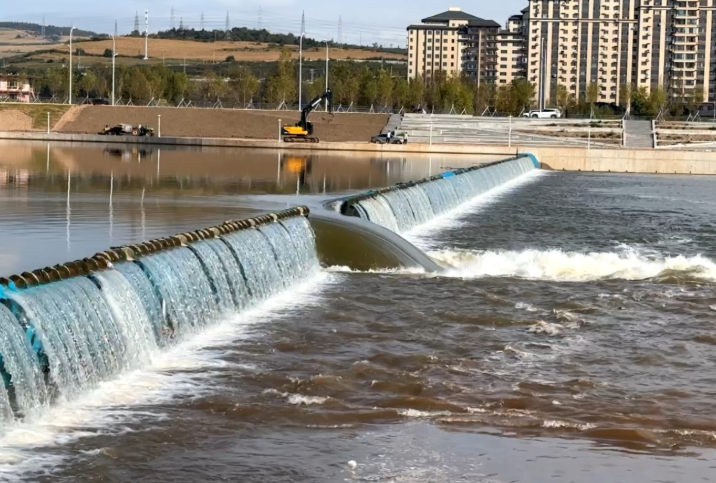
The key advantage of a rubber dam lies in its ability to be easily raised and lowered when needed. Unlike a fixed concrete dam that remains in one position permanently, a rubber dam can be adjusted within minutes. This flexibility provides precise control over river flow and water levels.
The operation process is straightforward and mainly involves two working states:
To create a water storage area, air or water is pumped into the rubber bladder, causing the dam to rise and form a barrier across the river. This function provides several important benefits. It can store water for irrigation during dry seasons, raise the upstream water level to supply canals or municipal water facilities, and create additional water head for small hydropower projects.
A control system continuously monitors the water level and adjusts the amount of air or water inside the bladder. An intelligent control system can automatically inflate or deflate the dam to maintain the required water height with accuracy.
The ability to quickly release water is one of the most important features of a rubber dam. When heavy rainfall occurs and flood conditions are expected, the bladder can be rapidly deflated by releasing the air or water inside. The dam then folds down flat onto the riverbed, allowing floodwater, ice, and large amounts of sediment to pass through without obstruction.
This quick response helps protect the dam structure, prevents river blockage, and reduces the risk of sudden upstream water level increases that could threaten downstream communities and property. This rapid adjustment capability provides a significant safety advantage compared with traditional fixed gates.
While the basic working principle remains the same, rubber dams can be divided into two main types based on the material used to inflate the bladder:
Air-filled rubber dams use compressed air to expand the bladder. They are often preferred for applications that require fast inflation and deflation because air systems can respond quickly and are relatively easy to operate and maintain. Air is readily available, and the pumping system can be kept running with simple equipment. In addition, air-filled systems are less affected by freezing conditions, making them suitable for cold regions. BIC focuses extensively on air-filled rubber dam solutions due to their fast response and reliable performance.
Water-filled rubber dams use river water to inflate the bladder. This type can reduce operating costs because it does not require a large air compressor system. However, water-filled dams generally take longer to inflate and deflate. They also require a reliable supply of clean water, and the filling pipes may face issues such as sediment or silt blockage over time.
Both types provide a flexible and efficient method for controlling river flow. Compared with traditional steel gates, rubber dams offer a simpler operating structure. Steel gates typically require heavy lifting equipment and more complex mechanical systems, while a rubber dam mainly relies on a pump system and control unit. This simple design makes rubber dams easier to operate, maintain, and manage with high reliability.
Rubber dams play an important role in improving water management and supporting communities. They help farmers by storing river water after the monsoon season ends, allowing the stored water to be released gradually for irrigation. This simple method of water storage can prevent crop failures caused by water shortages. Rubber dams also support urban water supplies by maintaining river levels high enough for water intake and treatment facilities. For applications requiring solutions that are cost-effective, quick to install, and durable, rubber dams offer significant advantages.
As a dedicated rubber dam manufacturer in China, BIC is committed to advancing this technology and providing reliable solutions for modern water management. We have contributed to various important water projects, including the Thailand PPY Hydraulic Elevator Dam Project, demonstrating our commitment to improving water resource management through innovative engineering. With years of industry experience and numerous completed projects, we provide customized rubber dam solutions designed to meet the unique requirements of different rivers and applications.
Compared with traditional steel gate dams, rubber dams require significantly lower construction costs while offering long service life and minimal maintenance requirements. During flood conditions, they can be quickly deflated and lowered to the riverbed, reducing the risk of structural damage and improving overall flood management safety.
The era of relying on massive, fixed structures for river management is gradually changing. The future of water control is moving toward solutions that are simpler, smarter, and more flexible — and rubber dam technology is an important part of this transformation. These innovative systems help conserve water, reduce flood risks, and support renewable energy development while allowing rivers to maintain a more natural flow.
As a leading rubber dam manufacturer in China, BIC is dedicated to providing advanced air-filled rubber dam solutions for modern water management needs. We make river control more efficient, reliable, and practical through proven technology and customized engineering. By adopting smarter water management solutions, we can help protect water resources and ensure that rivers continue to support communities for generations to come.