News
Water resources are essential to agricultural production, economic development, and environmental sustainability. However, the uneven distribution of rainfall, seasonal changes in river flows, and increasing frequency of extreme weather events make water management increasingly challenging. Dams play an important role in addressing these challenges by storing, regulating, and distributing water according to different demands.
Beyond their traditional function of water storage, modern dams serve multiple purposes in irrigation development, agricultural drainage management, and flood control. Through coordinated reservoir operations, water control gates, spillways, and associated hydraulic structures, dams help maintain a more balanced relationship between water availability and water demand.
Understanding the role of dams in irrigation, drainage, and flood control also provides insight into how integrated water infrastructure supports agricultural productivity and regional water security.
Agricultural water demand does not always coincide with natural water availability. In many regions, rainfall is concentrated during certain seasons, while crops require a relatively stable water supply throughout their growing cycles.
Dams address this imbalance by storing surplus river water during periods of high flow and releasing it when natural supplies become insufficient. The reservoir formed behind a dam acts as a strategic water storage facility, allowing water resources to be distributed over longer periods rather than depending entirely on immediate rainfall or river discharge.
This function is particularly important in arid and semi-arid regions, where seasonal droughts and irregular precipitation can significantly affect crop production.
Dams are often the primary water storage component of larger irrigation systems. Water released from a reservoir can enter main canals, diversion channels, pipelines, and distribution networks before reaching agricultural fields.
Water intake structures and regulating gates help control the volume and timing of water deliveries. This makes it possible to distribute water according to agricultural requirements and reduce fluctuations in downstream supply.
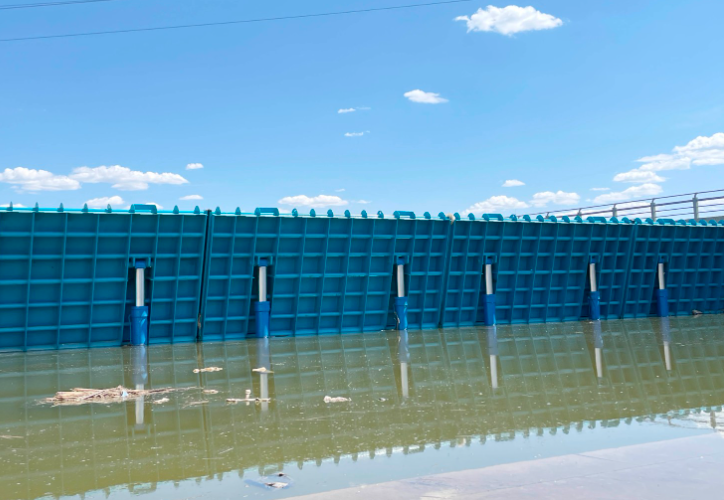
Adjustable hydraulic structures, such as hydraulic elevator dams, can also contribute to irrigation water management by regulating river levels and retaining water for downstream use.
Reliable irrigation water availability supports crop growth, increases the flexibility of planting schedules, and reduces dependence on unpredictable rainfall.
However, effective irrigation depends on more than reservoir storage capacity. Water allocation, canal efficiency, evaporation, conveyance losses, and field-level irrigation practices all influence the final amount of water reaching crops.
Consequently, dams are most effective when integrated with well-managed irrigation networks and appropriate water distribution strategies.
While irrigation focuses on delivering water to agricultural land, drainage performs the opposite but equally important function: removing excess surface water and groundwater from the crop root zone.
The relationship between irrigation and drainage is essential to maintaining productive agricultural soils.
Excessive irrigation, heavy rainfall, and insufficient natural drainage can cause groundwater levels to rise. When water accumulates around plant roots, soil aeration decreases, restricting the oxygen available for healthy crop development.
In arid and semi-arid regions, prolonged waterlogging can also contribute to soil salinization. As groundwater moves upward through the soil, dissolved salts may accumulate near the surface through evaporation.
Dams contribute to drainage management primarily through broader water-level regulation and coordinated water resource operations. By controlling upstream storage and downstream releases, they can help maintain suitable water levels in rivers and receiving channels connected to agricultural drainage networks.
In large irrigation schemes, drainage channels collect excess water from agricultural fields and transport it toward rivers, reservoirs, or designated discharge areas.
The effectiveness of these systems depends partly on the water level in the receiving water body. If downstream river levels become too high, gravity drainage may be restricted, potentially causing water to accumulate in low-lying areas.
Water control structures and adjustable gates can help regulate water levels and discharge conditions at key points within the drainage network. In some systems, pumping stations work alongside these structures to remove excess water when gravity discharge is insufficient.
It is important to recognize that dams do not replace agricultural field drains, collector channels, or pumping facilities. Their contribution is mainly at the river basin and water-control system levels, where coordinated operations can improve drainage conditions.
Another important aspect of drainage management is the handling of irrigation return flows.
Some of the water delivered to agricultural land eventually returns to drainage channels as surface runoff or groundwater discharge. Depending on local conditions, this water may contain dissolved salts, nutrients, and agricultural chemicals.
Reservoir and river operations can influence where and when these drainage flows are discharged, reused, or transported downstream. Effective management therefore requires coordination between irrigation delivery, drainage capacity, and water quality protection.
The Food and Agriculture Organization emphasizes that agricultural drainage management must address waterlogging, salinity, drainage water quality, and the safe disposal or reuse of drainage flows.
Flood control is another major function of dams, particularly in river basins exposed to seasonal rainfall, snowmelt, or extreme precipitation.
By temporarily storing excess water and regulating downstream discharge, dams can reduce flood peaks and help protect communities, agricultural land, and infrastructure.
During heavy rainfall, river discharge can increase rapidly and exceed the carrying capacity of downstream channels.
Flood control reservoirs provide temporary storage for a portion of this excess runoff. Instead of allowing the entire incoming flood volume to pass downstream immediately, the reservoir retains water and releases it gradually when downstream conditions permit.
This process is commonly described as flood peak attenuation.
The effectiveness of flood control depends on available reservoir storage, the magnitude of incoming floods, and the timing of water releases. Reservoir operations can also be coordinated across multiple dams within the same river basin to improve overall flood management.
Spillways and discharge gates are essential hydraulic components of dam flood management systems.
When reservoir levels rise, spillways provide a controlled route for releasing excess water. Adjustable gates allow operators to regulate discharge according to reservoir conditions and downstream flow requirements.
Hydraulic systems can support the opening, closing, and positioning of these gates. For example, hydraulic elevator dam systems use hydraulic cylinders to raise gate panels for water retention and lower them to facilitate flood discharge.
Similarly, inflatable rubber dams can retain water when inflated and create a more open flow passage when deflated. This operating flexibility makes them useful in certain river regulation, irrigation, and flood discharge applications.
The hydraulic behavior of these structures, including discharge capacity and energy dissipation, is an important part of safe and effective water management. Further technical principles can be explored in this guide to the hydraulics of dams and reservoirs.
Flood control dams provide benefits beyond the immediate river channel.
By regulating high flows, they can reduce the frequency and severity of downstream flooding, helping protect farmland, transportation networks, residential areas, and industrial facilities.
In agricultural regions, reduced flood exposure can limit crop losses, soil erosion, and damage to irrigation infrastructure.
Nevertheless, dams cannot eliminate all flood risks. Extremely large flood events may exceed available reservoir storage, while unexpected inflows or operational constraints can complicate flood management. Dams therefore need to function as part of a broader flood risk reduction strategy.
One of the greatest challenges in modern water resource management is coordinating the different functions of a multipurpose dam.
Irrigation systems generally benefit from maintaining sufficient water storage, especially before dry seasons. Flood control, on the other hand, requires available reservoir space to temporarily accommodate incoming floodwater.
These objectives can sometimes conflict.
For example, maintaining a high reservoir level may improve irrigation water security but reduce the storage capacity available during heavy rainfall. Conversely, releasing water in advance of an anticipated flood may create additional storage space but affect the water available for agricultural use.
Effective reservoir management therefore depends on seasonal operating rules, hydrological forecasting, downstream channel conditions, and coordination among water management authorities.
Drainage requirements must also be incorporated into these decisions. Excessive water retention or poorly coordinated releases may affect downstream drainage conditions, particularly in low-lying agricultural areas.
Modern water management increasingly relies on real-time monitoring, water-level sensors, discharge measurements, and coordinated gate control to improve operational decisions.
Although dams provide significant water management benefits, their construction and operation can also influence river ecosystems and downstream environments.
Changes in natural flow patterns may affect fish migration, sediment transport, river habitats, and seasonal floodplain processes. Reservoir sedimentation can gradually reduce available storage capacity, affecting both irrigation reliability and flood control performance.
Environmental flow management is therefore an important consideration. Appropriate water releases help maintain downstream ecological conditions while balancing agricultural, municipal, and flood management requirements.
Dam safety is equally important. Spillways, gates, foundations, drainage systems, and hydraulic equipment require regular inspection and maintenance to maintain reliable operation under changing hydraulic loads.
A sustainable approach to dam management considers not only water storage and discharge capacity but also the long-term performance of the entire river basin.
Dams play an essential role in irrigation, drainage, and flood control by regulating the movement and availability of water across different seasons and operating conditions.
For irrigation, they store surplus water and provide a more reliable supply during dry periods. For drainage, they support broader water-level regulation and coordination with agricultural drainage networks. For flood control, they temporarily store excess runoff and regulate downstream discharge to reduce flood peaks.
The effectiveness of these functions depends on appropriate hydraulic structures, coordinated reservoir operations, reliable monitoring, and consideration of environmental conditions.
As water management challenges become more complex, integrated dam systems and adjustable hydraulic structures will continue to play an important role in improving water resource utilization, agricultural resilience, and flood risk management.
Previous: None