News
Sluice gates and crest gates are two important hydraulic structures used in dams, reservoirs, irrigation networks, and flood control systems. Both help regulate water levels and manage water discharge, but they differ in their structural arrangements, operating principles, and typical engineering applications.
Understanding the difference between a sluice gate and a crest gate is important in hydraulic engineering because each type serves a different role in water control systems. A sluice gate primarily regulates water flow through an opening by moving a gate panel, while a crest gate is installed at the crest of a spillway to control reservoir levels and the discharge of excess water.
However, these two terms do not describe entirely separate categories. A vertical sliding gate can also function as a spillway crest gate when installed in the appropriate position. The main distinction lies in whether the gate is classified by its operating mechanism or its location and hydraulic function.
A sluice gate is a movable hydraulic barrier designed to regulate or stop water flow through a channel, opening, or outlet structure. It commonly consists of a flat gate panel that moves vertically within supporting guides or slots.
When the gate is raised, water passes through the opening beneath the gate panel. Lowering the panel reduces the opening and restricts the discharge. When fully closed, the gate can isolate the water passage, depending on its sealing arrangement.
The movement of a sluice gate is usually controlled by mechanical lifting equipment, electric actuators, or hydraulic cylinders. Smaller installations may use hand-operated mechanisms, while larger hydraulic structures generally require powered lifting systems.
● Water flow regulation: Adjusting the gate opening controls the amount of water released into downstream channels, irrigation networks, or drainage systems.
● Water level management: Sluice gates help maintain appropriate upstream water levels by controlling discharge from canals, reservoirs, and other water storage structures.
● Flood discharge: During periods of heavy rainfall or increased river flow, opening the gate allows excess water to be released or diverted through designated channels.
● Flow isolation: Fully closing the gate can isolate a section of a water system for inspection, maintenance, or operational control.
Sluice gates are widely used in irrigation canals, river control structures, reservoir outlets, drainage channels, wastewater treatment facilities, and hydropower installations.
In irrigation systems, they regulate water distribution between main canals and secondary channels. In drainage networks, they help control water discharge and prevent unwanted backflow. At dams, sluice gates may be incorporated into outlet structures to manage controlled releases.
The hydraulic behavior of a sluice gate depends on its opening height, upstream water head, downstream water level, and the geometry of the flow passage. Under submerged conditions, downstream water levels can significantly influence discharge, making hydraulic calculations essential for accurate flow regulation.
For a more detailed explanation of their working principles, see our article on Sluice Gate Design, Operation, and Applications.
A crest gate, also known as a spillway crest gate, is a movable gate installed at the crest of a spillway. Its primary function is to regulate the discharge of water from a reservoir and maintain the required upstream water level.
Unlike a conventional sluice gate, which is generally identified by its sliding mechanism, a crest gate is classified according to its installation position and role in a spillway system.
By changing the gate position, operators can adjust the effective water-control elevation and the available discharge opening. This allows a reservoir to retain water during normal operation while providing a controlled release route when inflows increase.
Crest gates can use different mechanical configurations depending on the spillway structure and hydraulic requirements.
Radial Gates (Tainter Gates)
Radial gates feature a curved upstream gate panel supported by radial arms connected to a fixed pivot point, known as a trunnion. The gate rotates around this pivot to regulate the water passage.
Their curved geometry helps transfer hydrostatic loads toward the supporting structure, making them suitable for large dam spillways and substantial water discharge applications.
Vertical Lift Gates
Vertical lift gates move upward and downward within supporting guides. Their position determines the available flow opening, allowing operators to regulate discharge through the spillway.
These gates are commonly used in dam structures where vertical movement and controlled gate positioning are required.
Hinged and Tilting Gates
Hinged or tilting gates rotate around a horizontal axis to change the effective crest elevation. Depending on their configuration, lowering the gate can allow water to pass over the structure, while raising it increases the retained water level.
These arrangements are particularly relevant to movable weirs and low-head hydraulic structures.
The operating mechanism and water passage are therefore determined by the specific crest gate design rather than by the term crest gate alone.
For additional information about spillway gate configurations, explore our article on Spillway Crest Gates and Their Role in Dam Water Control.
Although both structures regulate water flow, their engineering characteristics and primary functions are different.
Comparison Factor | Sluice Gate | Crest Gate |
Basic definition | A sliding gate used to control water flow through an opening | A gate installed at a spillway crest to regulate discharge and reservoir level |
Classification | Based mainly on gate movement and structure | Based mainly on installation position and hydraulic function |
Typical structure | Flat gate panel with supporting guides | Radial, vertical lift, hinged, or other movable gate configurations |
Operating mechanism | Primarily vertical sliding movement | Vertical lifting, rotation, or tilting, depending on design |
Water passage | Commonly flows beneath the gate panel | Depends on gate geometry and opening arrangement |
Main purpose | Regulating or stopping flow through a water passage | Controlling spillway discharge and reservoir water levels |
Typical applications | Irrigation canals, drainage systems, outlets, and water treatment facilities | Dams, reservoirs, spillways, and flood discharge structures |
Hydraulic considerations | Gate opening, upstream head, downstream tailwater, and flow conditions | Spillway geometry, crest elevation, gate position, hydraulic loading, and discharge capacity |
One important distinction is that a sluice gate and a crest gate are not necessarily mutually exclusive. For example, a vertical sliding gate installed above a spillway can be described both by its operating mechanism and its spillway function.
Therefore, the actual structural arrangement and hydraulic operating conditions are more important than the name used to describe the gate.
The most significant engineering difference between sluice gates and crest gates is how their positions influence the hydraulic conditions of the water system.
A sluice gate controls discharge by changing the size of the opening beneath its gate panel. As the gate rises, the flow passage becomes larger, allowing more water to move downstream under the available hydraulic head.
The water passing through the opening accelerates and may form a high-velocity jet downstream. Depending on the downstream water depth, the resulting flow may be free or submerged.
A hydraulic jump may also develop downstream, converting part of the flow's kinetic energy into turbulence and heat.
Consequently, sluice gate performance is closely related to gate opening, upstream and downstream water levels, discharge coefficients, and downstream energy dissipation.
A crest gate regulates the water level and discharge capacity of a spillway. Its position changes the effective control elevation or opening through which reservoir water can be released.
For example, a vertical lift crest gate can create a discharge opening beneath the gate when raised. A hinged crest gate can lower its effective barrier elevation to permit additional water release.
During normal reservoir operation, the gate arrangement helps retain the required water level. When inflows increase, the gate can be adjusted to release excess water through the spillway.
The resulting discharge depends on the gate geometry, opening, upstream head, downstream tailwater, and spillway configuration.
Unlike a simple channel sluice gate, crest gate operation must also be considered as part of the overall spillway hydraulic system, including approach flow, downstream flow conditions, and energy dissipation.
Both gate types contribute to water resource management, but they are generally integrated into different parts of hydraulic infrastructure.
Sluice gates are commonly installed at canal branches, water distribution points, and irrigation control structures. Their adjustable openings allow operators to regulate the water supplied to different sections of an irrigation network.
Crest gates may also be incorporated into irrigation reservoirs and movable weirs to maintain upstream storage levels while allowing controlled discharge.
Crest gates play an important role in reservoir operation. By adjusting the spillway opening, they help maintain normal operating levels and release excess water during high-inflow conditions.
Sluice gates may serve a complementary function through low-level outlets or other discharge passages, allowing water to be released independently of the main spillway.
Both gate types can contribute to flood management.
Sluice gates regulate discharge through designated channels and outlets, helping control river levels and drainage flows.
Crest gates provide an adjustable spillway control mechanism, allowing reservoir operators to release excess storage water in accordance with the operating strategy and downstream hydraulic conditions.
In large water control projects, these structures may work together with hydraulic actuators, water-level monitoring equipment, and centralized control systems to coordinate water release and storage.
Yes. Sluice gates and crest gates can operate together within the same dam or reservoir system because they can control different water passages and serve complementary functions.
For example, a reservoir may use a sluice gate in a low-level outlet to regulate controlled water releases, while crest gates manage discharge through the main spillway.
This arrangement provides different discharge routes for normal operation, reservoir level management, and flood response.
The coordinated operation of multiple gates also allows water managers to adjust releases according to changing inflows, storage requirements, and downstream conditions.
In addition, hydraulic lifting systems can provide the necessary operating force for large movable gates. Their configuration depends on gate geometry, water pressure, structural loads, and the required operating sequence.
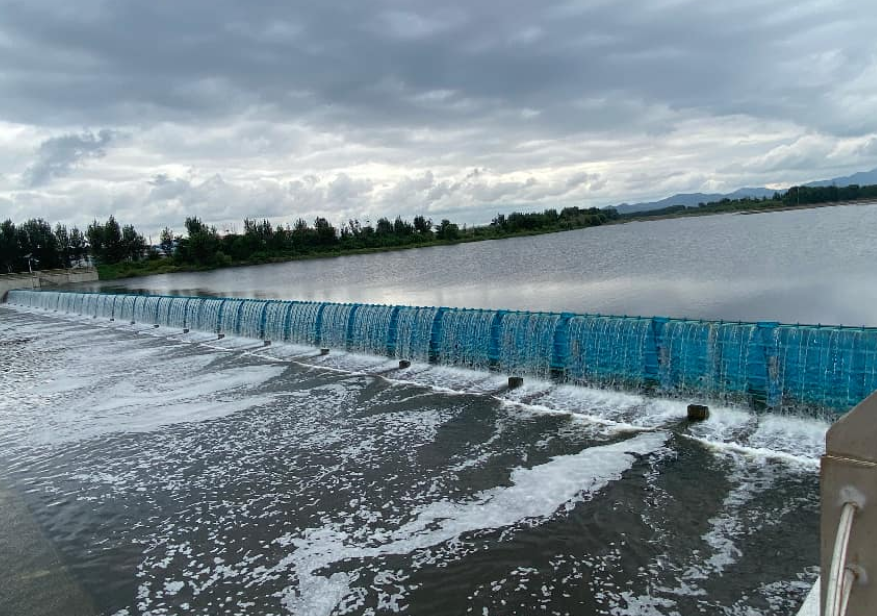
BIC's Hydraulic Elevator Dam illustrates another approach to movable water-control structures. Its hydraulic cylinders raise the gate panels to retain water and lower them to facilitate flood discharge. Such systems demonstrate how hydraulic actuation can support adjustable water-level and discharge control in dam infrastructure.
The difference between a sluice gate and a crest gate mainly concerns their classification, installation, and hydraulic functions.
A sluice gate is generally identified by its sliding gate mechanism and its ability to regulate water flow through an opening. A crest gate is identified by its position at a spillway crest and its role in controlling reservoir levels and spillway discharge.
Their structural configurations can overlap, as vertical lift or sliding gates may also be used as spillway crest gates. Understanding this distinction helps engineers evaluate the relationship between gate geometry, hydraulic performance, and overall water control system operation.
Both structures remain important components of modern hydraulic infrastructure, supporting irrigation, reservoir management, flood discharge, drainage, and dam safety.