News
Spillway design is one of the most critical aspects of dam engineering because it directly determines the safety, reliability, and hydraulic performance of a dam during extreme flood events. A spillway is a hydraulic structure designed to safely convey excess water from a reservoir to a downstream channel, preventing overtopping and potential dam failure. According to hydraulic engineering principles, inadequate spillway capacity is one of the leading causes of catastrophic dam failures worldwide. Modern design practices therefore focus not only on discharge capacity but also on energy dissipation, erosion control, and structural stability under extreme flow conditions.
For civil engineers, spillway design is not simply about creating an overflow path; it involves integrating hydrology, hydraulics, geotechnical conditions, and structural engineering into a single safe and efficient system.
The primary function of a spillway is to ensure controlled release of surplus water when reservoir levels exceed safe limits. During heavy rainfall or snowmelt, inflow to reservoirs can exceed storage capacity. Without a properly designed spillway, water may overtop the dam crest, leading to erosion and structural failure.
Spillways serve several essential purposes:
· Prevent dam overtopping and structural failure
· Regulate reservoir water levels
· Safely pass design floods downstream
· Reduce hydraulic pressure on dam structures
· Protect downstream communities and infrastructure
Modern dam safety standards emphasize that spillways must operate automatically under extreme conditions, without reliance on human intervention. This ensures continuous protection even during emergency scenarios.
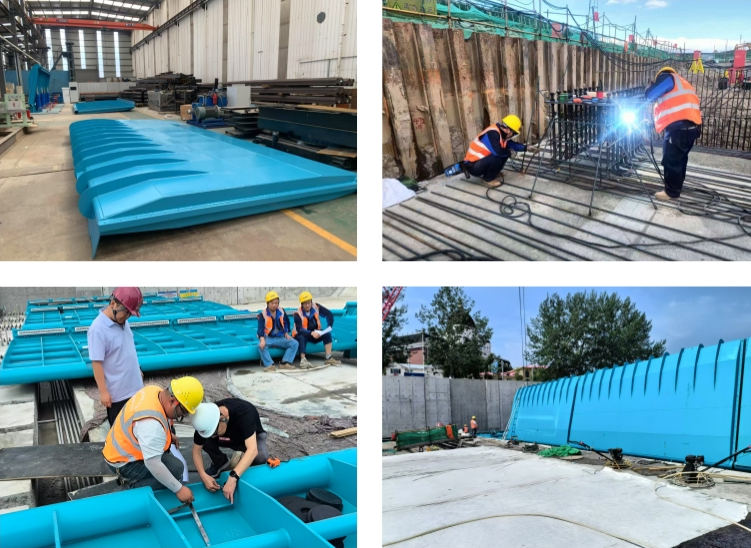
Spillway selection depends on dam type, topography, geology, and hydrological conditions. The most commonly used spillways include:
The ogee spillway is typically integrated into concrete gravity or arch dams. Its S-shaped profile is designed to match the natural trajectory of water flowing over a sharp-crested weir. This geometry minimizes flow separation and improves hydraulic efficiency. Ogee spillways are widely used in large dams due to their high discharge capacity and stable flow characteristics.
A chute spillway conveys water through a steep, open channel constructed along an abutment or downstream slope. It is especially suitable for earthfill and rockfill dams, where water must be safely guided away from the dam body. Because flow velocities are high, chute spillways require reinforced concrete linings and carefully designed energy dissipation structures at the outlet.
In this configuration, water flows over a crest and enters a channel running parallel to the dam axis before being redirected downstream. Side channel spillways are useful in narrow valleys where space constraints prevent direct downstream discharge.
This type uses a vertical intake shaft to transfer water into a tunnel or conduit downstream. It is commonly used in steep or confined topographic conditions where surface spillways are not feasible. However, it requires careful hydraulic design to prevent vortex formation and clogging.
Spillway design is fundamentally governed by hydrological and hydraulic calculations. Engineers must determine the maximum flood discharge, often referred to as the Probable Maximum Flood (PMF), and ensure the spillway can safely pass it.
The general discharge equation for overflow spillways is:
Q = C L H^(3/2)
Where:
· Q = discharge rate
· C = discharge coefficient
· L = effective crest length
· H = head over the spillway crest
This equation shows that discharge increases significantly with water depth, making accurate flood estimation essential for safe design.
Hydraulic analysis also considers:
· Flow regime (subcritical or supercritical flow)
· Velocity distribution along spillway surfaces
· Pressure distribution and potential cavitation zones
· Approach flow conditions and turbulence
One of the most important aspects of spillway design is controlling the immense kinetic energy of flowing water. Without proper energy dissipation, high-velocity flow can cause severe downstream erosion and compromise dam stability.
Common energy dissipation methods include:
These are reinforced concrete basins where hydraulic jumps occur, converting kinetic energy into turbulence and heat.
Concrete blocks placed in stilling basins to disrupt flow and enhance energy loss.
These structures redirect high-speed flow into the air, dissipating energy through jet breakup and downstream dispersion.
A stepped geometry increases turbulence and reduces flow velocity along the chute.
Effective energy dissipation is essential to ensure long-term safety of both the dam foundation and downstream riverbed.
Spillway structures must withstand extreme hydraulic forces, abrasion, and potential cavitation damage. Engineers must carefully evaluate:
· Foundation stability and rock quality
· Erosion resistance of spillway surfaces
· Uplift pressure beneath structures
· Thermal and structural stress in concrete
· Seepage control around abutments
In embankment dams, spillways are often constructed separately from the main dam body to avoid overtopping erosion risks.
Spillway capacity is determined using hydrological modeling based on:
· Historical rainfall data
· Watershed runoff characteristics
· Probable Maximum Precipitation (PMP)
· Flood routing through reservoirs
Reservoir routing is used to simulate how inflow hydrographs translate into outflow hydrographs, helping engineers determine the required spillway size and crest elevation.
Accurate flood estimation is critical because underestimating design floods can lead to catastrophic dam failure, while overdesign increases construction costs significantly.
At high flow velocities, negative pressure zones may form along spillway surfaces, leading to cavitation damage. This can rapidly erode concrete and compromise structural integrity.
To mitigate this, engineers use:
· Air vents and aerators
· Smooth curvature profiles
· High-strength concrete linings
· Surface polishing techniques
Proper cavitation control is especially important in high-head dams.
Recent advances in spillway engineering focus on improving safety, efficiency, and environmental performance. These include:
· Use of CFD (Computational Fluid Dynamics) for flow simulation
· Roller-compacted concrete (RCC) spillways
· Eco-friendly spillway channels with fish passage considerations
· Real-time monitoring systems for flow and structural health
· Adaptive spillway gate automation systems
These innovations allow engineers to design more resilient hydraulic structures that can adapt to changing climate patterns and extreme weather events.
Spillway design is a fundamental discipline in civil and hydraulic engineering that ensures the safe operation of dams under extreme hydrological conditions. A well-designed spillway integrates hydraulic efficiency, structural integrity, and energy dissipation to protect both the dam and downstream communities.
For civil engineers, mastering spillway design requires a strong understanding of fluid mechanics, flood hydrology, and structural behavior under dynamic loading conditions. As climate variability increases the frequency of extreme floods, the importance of robust spillway systems continues to grow, making them one of the most critical components in modern dam infrastructure.