News
Inflatable rubber dams are adjustable hydraulic barriers used for water retention, water level control and flood discharge. Unlike many conventional dam structures, they have a simple design without complex moving components such as swivel joints. Their smooth concrete foundation and flexible rubber bladder also help distribute hydraulic forces evenly, simplifying structural reinforcement and installation.
An inflatable rubber dam can be installed on vertical, inclined or irregular dam walls, as well as curved or angled dam crests. It may also be mounted on a suitable existing dam structure. Because of its relatively low construction height, the system can integrate naturally into the surrounding landscape.
The rubber bladder can normally be repaired or replaced without rebuilding the entire concrete foundation. Depending on the dam size, site accessibility and extent of damage, repair or replacement may be completed within several days or weeks. These characteristics make inflatable rubber dams cost-effective, adaptable and reliable solutions for different water management projects.
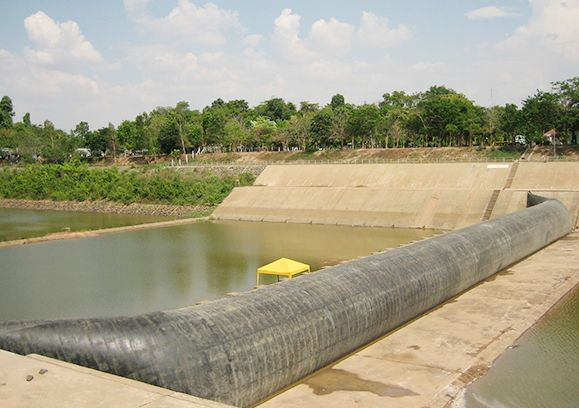
The operating height of an inflatable rubber dam can be adjusted by changing the volume or pressure of the air or water inside the bladder. When inflated, the dam retains water and raises the upstream level. When deflated, it lowers toward the foundation and increases the available discharge section.
Important properties include:
· Adjustable dam height and upstream water level
· Air-filled or water-filled operating options
· Simple concrete foundation and anchoring arrangement
· No complex exposed lifting mechanisms
· Low flow resistance when fully deflated
· Adaptability to different channel and dam geometries
· Relatively low visual impact
· Repairable and replaceable rubber bladder
· Compatibility with automatic and remote-control systems
These properties allow an inflatable rubber dam to be customized according to the river width, required dam height, flow conditions, foundation and operating objectives.
In hydropower projects, rubber dams retain water to help maintain the hydraulic head required by power-generating turbines. The dam height can be coordinated with turbine operation so that the required upstream water level is maintained under different discharge conditions.
Rubber dams can also be used to increase the storage capacity of existing dams or weirs. This may improve water utilization and turbine operating conditions without constructing a completely new high concrete barrier.
Precise water level control is essential for navigation and shipping channels. An inflatable rubber dam can maintain the upstream retention level within a controlled range, helping provide sufficient water depth for vessels.
Water-level sensors, pumps or blowers, valves and automatic controls can be used to adjust the bladder pressure. When the upstream level rises above the set point, the dam can be gradually lowered to release more water. When the level falls, the bladder can be reinflated.
Inflatable rubber dams can operate as relief structures in flood-control systems. When installed in a dike, they can direct water into polders or designated flood-storage areas in a controlled manner.
During normal conditions, the dam remains inflated to retain water. When river discharge increases, it can be lowered or completely deflated to open the channel and reduce obstruction to floodwater.
Because they can be operated relatively quickly, rubber dams may also be used as mobile or temporary flood-protection barriers. In coastal protection projects, suitable systems can function as storm-tide barriers. These applications require appropriate control systems, emergency deflation arrangements and protection against debris, ice and abrasion.
In agricultural areas, rubber dams are used to raise river or canal levels for irrigation diversion. They may also retain water for the direct watering of crops.
In regions with long dry periods, an irrigation rubber dam can increase seasonal water storage and extend the availability of water. This supports a more continuous and economical supply for farms and irrigation networks.
Project design should consider seasonal river flow, irrigation demand, intake elevation, sediment conditions and the required storage capacity.
Inflatable rubber dams can separate seawater from freshwater in estuaries, tidal rivers and coastal agricultural areas. By maintaining the upstream freshwater level, they help limit seawater intrusion into irrigation channels and freshwater systems.
The rubber bladder may be designed for freshwater, seawater or brackish-water conditions. Special configurations can also retain water from the downstream side. For these projects, the membrane, anchoring system and operating pressure must be designed for reverse hydraulic loads and saline exposure.
Rubber dams and inflatable gates can be installed in sewage systems for water regulation, wastewater retention and sewer flushing.
During heavy rainfall, the inflow to a combined sewer system may exceed the treatment plant’s immediate processing capacity. An inflatable gate can temporarily retain part of the flow, allowing the sewer channel to serve as an intermediate storage reservoir. The retained wastewater can then be released after the peak inflow has passed.
Inflatable systems used in sewers should provide:
· Reliable operation in wastewater
· Adaptability to the sewer cross-section
· Resistance to dirt, chemicals and corrosion
· Remote monitoring and control
· Safe access for cleaning and maintenance
Because of their flexibility and operational reliability, inflatable rubber dams can also be used for:
· Water sports and recreational areas
· Ecological water-level management
· Urban river landscape projects
· Groundwater recharge
· Cooling-water retention
· Industrial water supply
· Aquaculture
· Temporary water diversion
· Seasonal water storage
The final design can be customized according to the hydraulic conditions, water quality, environmental requirements and operating objectives of each project.
Before designing a rubber dam, the project owner should provide:
· River or channel width
· Required dam height
· Upstream and downstream water levels
· Normal and maximum flow rates
· Flood-discharge requirements
· Foundation and soil information
· Sediment, debris and ice conditions
· Water quality and salinity
· Required inflation and deflation time
· Power supply and control requirements
Air-filled systems are generally suitable when faster inflation and deflation are required. Water-filled systems may provide stable operation but usually require more time and water-handling equipment. The appropriate option should be selected according to the actual hydraulic and operational conditions.
Inflatable rubber dams provide an adaptable solution for hydropower, navigation, flood protection, irrigation, coastal water management and wastewater regulation. Their adjustable height, simple supporting structure and broad installation flexibility make them suitable for many low-head water-control projects.
Beijing IWHR Corporation provides inflatable rubber dam design, manufacturing, installation and technical support. View our rubber dam projects or contact us to discuss your project requirements.