News
A low navigation dam, also called a low-head navigation dam, is built across a river primarily to maintain enough upstream water depth for commercial or recreational navigation.
Unlike large storage dams, which may be constructed for hydropower generation, flood control, irrigation, or long-term reservoir storage, navigation dams generally create a relatively small difference between upstream and downstream water levels.
Their main functions include:
· Maintaining a minimum navigable channel depth
· Regulating the upstream navigation pool
· Allowing river flow to pass safely
· Supporting operation of an adjacent navigation lock
· Passing higher river flows during flood conditions
· Minimizing interference with vessels when river conditions permit open navigation
USACE describes navigation dams as structures that impound water to provide sufficient navigable depth upstream. Depending on the design, they may contain gated spillways, movable sections, fixed overflow sections, or combinations of these features.
Because the hydraulic head is relatively low, gate selection is different from that for a high-head storage or hydropower dam.
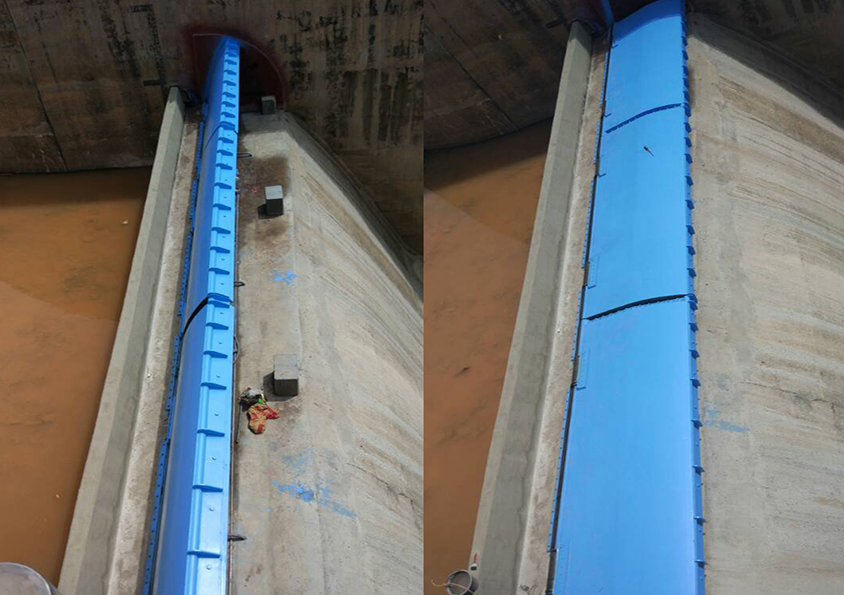
The traditional answer is the bear trap gate because its operating characteristics are well suited to low-head water-control structures.
Bear trap gates were developed for applications where the required water level difference is relatively small.
Rather than requiring a very tall gate tower or heavy lifting equipment, the system uses hydraulic pressure to raise the gate leaves.
This makes the concept naturally suited to low dams, navigation weirs, and similar river-control structures.
One of the important requirements of some movable navigation dams is the ability to reduce obstruction when river levels rise.
A bear trap gate can be lowered toward the dam sill, creating a much less obstructed flow path than a permanently raised barrier.
This can help:
· Pass high river flows
· Reduce upstream afflux
· Pass floating debris
· Reduce obstruction during certain navigation conditions
A bear trap gate normally consists of two hinged leaves.
Water from the upstream pool can be introduced beneath the leaves. The resulting hydraulic pressure raises the lower leaf, which in turn raises the upper portion of the gate.
To lower the gate, water beneath the leaves is released downstream.
Modern USACE documentation describes this basic operating principle as using pressure from the upper pool to raise and hold the gate and releasing water toward the lower pool to lower it.
Vertical lift gates and some other dam gate designs require substantial hoists, lifting cables, towers, or mechanical equipment.
One historical advantage of the bear trap gate is that hydraulic pressure does much of the operating work.
As a result, the requirement for large electric or mechanical lifting systems can be reduced.
During lower river flows, the gate can be raised to increase the upstream water level.
This provides the depth required by vessels operating in the navigation channel.
When natural river discharge increases sufficiently, the gate can be lowered so that more water passes through the dam.
A bear trap gate usually contains two movable leaves connected to the dam structure.
The operating sequence can be simplified into four stages.
Water from the upstream pool is admitted beneath or between the gate leaves.
This creates pressure beneath the movable structure.
The pressure generates an upward force on the lower leaf.
The lower leaf rises and pushes or supports the upper leaf, causing the complete gate system to move upward.
Some designs use buoyancy to assist this movement.
Once raised, the gate creates a higher effective crest.
The upstream water level therefore increases, helping maintain the navigation pool depth required by vessels.
When the gate needs to be lowered, the water supporting the gate is discharged toward the downstream side.
As pressure decreases, the leaves descend toward their lowered position.
This relatively simple hydraulic principle made bear trap gates attractive for early movable navigation dams.
Although designs vary, a typical bear trap gate may include:
Component | Main Function |
Upper leaf | Forms part of the water-retaining surface |
Lower leaf | Supports and helps raise the gate |
Hinges | Allow movement of the leaves |
Gate chamber | Receives water used to operate the gate |
Inlet system | Introduces upstream water |
Outlet system | Releases water downstream |
Seals | Control leakage between moving components |
Dam sill | Supports the gate in its lowered position |
The exact geometry depends on the head, gate width, required pool elevation, hydraulic conditions, structural loads, and operating arrangement.
For appropriate low-head applications, bear trap gates offer several characteristics that explain their historical association with low navigation dams.
The upstream water itself can provide much of the force required to operate the gate.
Compared with large vertical lift gates, the system may require less external lifting equipment.
The gate leaves can collapse toward the dam sill, reducing the obstruction to river flow.
The structure can change between a raised water-retaining configuration and a lowered configuration.
The gate provides a means of raising upstream water levels during periods of insufficient natural river depth.
Despite these advantages, bear trap gates are not necessarily the preferred solution for a new navigation dam.
Because two movable leaves and an internal hydraulic chamber are involved, sealing can become complicated.
Leakage can affect both gate efficiency and reliability.
Mechanical components, hinges, seals, and hydraulic passages may be located close to or below water level, making inspection and maintenance more difficult.
Sediment accumulation, ice, vegetation, and floating debris can interfere with movable components.
Adequate pressure must be available to initiate and control gate movement.
Some systems may require additional assistance when the available head is insufficient.
Modern hydraulic cylinders, electric hoists, monitoring equipment, and automated controls have made other gate designs increasingly practical.
For these reasons, modern USACE navigation-dam guidance does not treat the bear trap gate as the default gate for new projects. Earlier navigation systems may still contain them, but contemporary projects usually compare several alternatives.
Bear trap gates and wicket gates are both associated with movable navigation dams, but they should not be confused.
A bear trap gate normally consists of two large hinged leaves operated by water pressure.
A wicket gate, in the navigation-dam sense, is generally a narrower bottom-hinged panel that can be raised to retain water and lowered toward the riverbed when the dam does not need to maintain the navigation pool.
Wicket gates have been used in navigation dams for more than a century. Modern versions may use hydraulic systems rather than the older manual operating methods.
USACE guidance specifically identifies wicket gates as an option for navigable-pass dam spillways, where creating a wide passage without intermediate piers can be important.
Feature | Bear Trap Gate | Wicket Gate |
Basic structure | Two hinged leaves | Individual hinged panels |
Operation | Mainly hydraulic pressure | Hydraulic/mechanical operation |
Typical head | Low | Low |
Navigation use | Historical low navigation dams | Movable navigable-pass dams |
Lowered position | Near crest/sill | Folds toward riverbed or sill |
Modern use | Limited/specialized | Still relevant for selected projects |
A tainter gate, also known as a radial gate, consists of a curved gate leaf supported by radial arms connected to trunnions.
Tainter gates are widely used because their curved structure transfers water loads efficiently to the supporting piers.
Compared with bear trap gates, tainter gates generally offer:
· More conventional mechanical operation
· Efficient force transfer
· Relatively low hoisting forces
· Reliable regulation of large spillway flows
· Easier integration with modern control systems
USACE documentation states that tainter gates have been used in many more recently constructed navigation dams.
Therefore, there is an important distinction:
Traditional civil-engineering answer: Bear trap gate.
Modern navigation-dam engineering: Tainter gates, wicket gates, vertical lift gates and other systems may be selected according to project requirements.
A vertical lift gate moves vertically between guides installed in the dam piers.
It can provide a clear opening when fully raised and can accommodate substantial changes in water level.
However, large gates require significant lifting structures and hoisting equipment.
A roller gate uses a large cylindrical or curved structure that moves along tracks in the dam piers.
Roller gates have historically been installed at several low-head navigation dams and can accommodate wide spillway openings.
Their mechanical complexity and maintenance requirements, however, can be greater than those of some alternatives.
A drum gate is another type of movable crest gate that uses hydraulic pressure to raise or lower a curved gate structure.
Like bear trap gates, drum gates have historical applications but are less commonly selected for new navigation dams.
Wicket gates are particularly important where part of the dam must be completely lowered to provide a navigable river passage during favorable river conditions.
There is no single gate type that should automatically be specified for every modern low-head navigation project.
Engineers normally consider several factors.
Gate geometry must suit the upstream and downstream water-level difference.
The gate must maintain the target navigation pool during low-flow periods.
The dam must safely pass high river flows without creating unacceptable upstream water levels.
Some projects need a completely open navigable pass, while others route vessels through a navigation lock throughout the year.
Wider gates can reduce the number of piers but may increase structural and mechanical demands.
Rivers carrying significant debris, sediment, or ice may require a gate arrangement that minimizes blockage.
Navigation infrastructure often operates for decades, making mechanical reliability especially important.
Bearings, seals, hinges, hoists, hydraulic cylinders, cables, and structural members must remain accessible for maintenance.
Modern dams increasingly use remote monitoring, automated gate controls, water-level sensors, and centralized operating systems.
Initial construction cost should not be considered alone. Inspection, maintenance, corrosion protection, component replacement, energy consumption, and downtime all affect long-term project economics.
If the question is asked in the traditional civil-engineering or examination context:
A bear trap gate is generally used for low navigation dams.
This answer appears in engineering examination material and educational resources because bear trap gates have historically been closely associated with low-head movable navigation dams.
For an actual modern project, however, engineers should not select a bear trap gate solely because the dam has a low head.
The final gate may instead be a:
· Tainter gate
· Wicket gate
· Vertical lift gate
· Roller gate
· Hinged crest gate
· Other specialized movable gate
The decision depends on hydraulic performance, navigation requirements, structural design, maintenance strategy, automation, cost, and site conditions.
So, which type of gate is generally used for low navigation dams?
The classic answer is the bear trap gate.
Its two-leaf movable design, hydraulic operation, low-head suitability, and ability to lower toward the dam sill made it an important solution for traditional navigation dams.
However, modern dam engineering has evolved. Bear trap gates should now be understood as one historical and specialized solution rather than the universal standard for every new low-head navigation project. Contemporary navigation dams may use tainter gates, wicket gates, vertical lift gates, roller gates, or other movable systems based on the site's hydraulic, structural, operational, navigation, and maintenance requirements.
Understanding this distinction provides a more accurate answer than simply memorizing a gate type—and is essential when moving from engineering theory to actual navigation dam design.
Previous: None