News
Compare hydraulic/moveable flood barriers with traditional defenses (sandbags, levees, seawalls). Learn costs, deployment speed, maintenance, environmental impacts, and when to choose each.
Flood risk is rising worldwide — heavier storms, higher tides, and faster urbanization mean communities must choose smarter defenses. Two broad approaches dominate: traditional measures (sandbags, levees, seawalls) and hydraulic/moveable or engineered flood barriers (retractable gates, modular temporary systems, water-filled walls). This article compares them head-to-head so property owners, planners, and facility managers can decide which is best for their site and budget.
Hydraulic/moveable barriers (retractable gates, inflatable or panel systems) win for speed of deployment, reusability, lower labor and less visual/permanent impact in many urban sites.
Traditional protections (levees, seawalls) are best where very long-term, permanent defense is required and budget for heavy civil works exists — but they are costly, slow to build, and can harm coastal ecology.
Sandbags are cheap and familiar but labor-intensive, temporary, and leak-prone — suitable only for short-duration, low-height threats or emergency last-resort use.
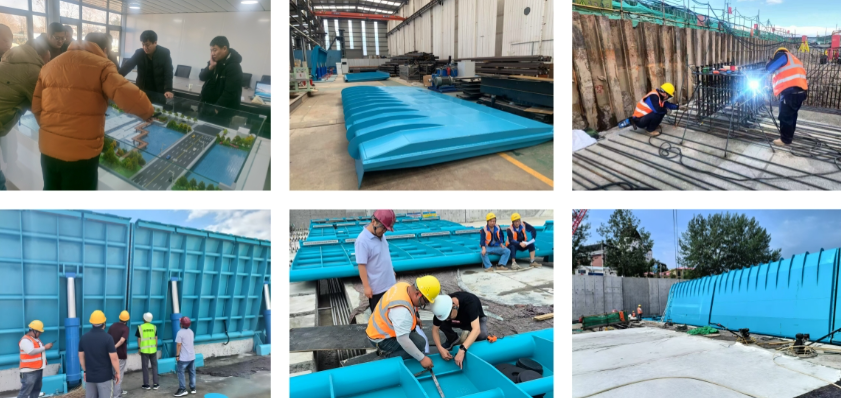
"Hydraulic" in practice covers moveable / mechanized flood defenses such as rotating or lifting gates (big civil installations like the Thames Barrier), plus engineered temporary and modular systems that rely on mechanical deployment, interlocking panels, or water-inflated membranes. These systems can be permanently installed then raised/closed during a surge, or stored and deployed when needed. Example: the Thames Barrier — a movable gate system protecting London — operates by raising heavy steel gates to block storm surges.
Sandbags: cheap, accessible, but require huge manpower and supplies to protect even a single house; they are not fully watertight and degrade with time.
Levees and seawalls: heavy civil works offering long-term protection but expensive, time-consuming to build and maintain, and can cause negative coastal/ecosystem impacts.
Natural / green infrastructure: wetlands, dunes, salt marsh restoration — highly desirable for resilience but often need space and long lead times to establish.
Hydraulic/moveable: Many modern systems deploy quickly (minutes to hours) when pre-installed or pre-positioned — critical for fast-onset storm surges. Temporary engineered barriers (interlocking panels, water-filled tubes) can also be positioned rapidly if preplanned.
Traditional (sandbags): Very slow — building an effective sandbag wall needs many people and large quantities of sand; not practical for sudden floods.
Hydraulic/moveable: Higher upfront capital for sophisticated movable gates or mechanized systems and ongoing maintenance (mechanical systems, controls). However, for frequently threatened urban assets the lifecycle cost can be lower than repeatedly repairing damage behind less robust defenses. Analyses comparing flood-proofing options show non-structural and engineered temporary measures can be cost-effective depending on frequency and magnitude of flooding.
Traditional: Levees/seawalls are capital-intensive and sometimes cheaper to operate afterwards but may require costly upgrades as sea levels rise.
Hydraulic/moveable: Very effective when designed for the local hazard and properly maintained — e.g., large retractable barriers have protected major cities from high tides. But they rely on mechanical systems and need maintenance and contingency planning.
Sandbags & temporary measures: Can reduce damage for low-level floods but are less reliable for higher water or prolonged inundation.
Hydraulic/moveable: Can be largely invisible when not in use (gates stowed below waterline or panels stored), reducing permanent impacts on views and ecosystems. But large civil projects can still alter sediment transport and habitats (as critics point out for some mega projects).
Traditional hard engineering: Seawalls and continuous levees can disconnect coasts from natural processes and hurt habitats; green infrastructure scores higher for biodiversity but may not offer equivalent protection alone.
Hydraulic/moveable: Require scheduled mechanical and electrical maintenance and tested operating procedures. Failures can be catastrophic if not maintained. Real-world projects (especially very large ones) also face big maintenance budgets and governance challenges.
Sandbags: Require replacement, can rot, and offer little protection if improperly stacked or for long durations.
A large mechanical barrier across the Thames that is raised for storm surges. It has protected London since the 1980s and is a high-profile example of a permanent movable flood barrier used for a major urban area.
A system of mobile seabed gates intended to protect Venice from "acqua alta." MOSE demonstrates both the potential of moveable barriers and the complexity of mega-projects — technical, environmental, and governance challenges have made the project controversial and costly.
Interlocking portable panels, inflatable tubes, and engineered water-filled systems (e.g., AquaFence, Water-Gate style solutions) have been successfully used to protect individual buildings, train stations, and roadways — often quicker and cleaner than sandbags.
Small sites / homeowners: Passive or affordable temporary systems (pre-stacked panels, water-filled tubes) or home flood-proofing are often the most cost-effective. Sandbags are cheaper initially but expensive in labor and logistics.
Critical infrastructure & cities: Investing in moveable hydraulic barriers or a hybrid (permanent + deployable) approach is common because the value of what’s protected justifies higher upfront costs. But plan for long-term maintenance budgets and governance.
· Assess the hazard: flood depth, speed, frequency, and lead time (forecasting).
· Value at risk: assets’ replacement value, critical services, and human safety.
Site constraints: space, heritage/visual concerns, environmental sensitivity.
· Operational capacity: can the local team deploy temporary systems quickly and safely? Is technical maintenance available for mechanical systems?
· Budget & financing: include lifecycle maintenance, not just initial purchase.
· Mix & match: often the best solution is hybrid — combine nature-based measures, permanent structures in key places, and deployable engineered barriers for flexibility. See academic and practical guidance for cost-benefit comparison.
| Approach | Pros | Cons |
| Hydraulic / Moveable Barriers | Rapid deployment (if installed), reusability, less permanent visual impact, high effectiveness for designed events. | High capital & maintenance costs; mechanical failure risk; complex governance for large systems. |
| Levees & Seawalls | Permanent, continuous protection for long stretches. | Very expensive to build/upgrade; ecological impacts; may need raising as sea levels rise. |
| Sandbags / Manual Traditional | Low initial cost; flexible in emergencies. | Labor-intensive, temporary, seepage issues, impractical for large scale or high floods. |
| Green infrastructure | Multiple co-benefits (biodiversity, recreation, carbon). | Requires space and time to establish; may not protect against extreme surge alone. |
Q: Are hydraulic barriers immune to climate change effects?
A: No — they must be designed for future sea-level rise and extreme events. Many projects need periodic upgrades or adaptive management to remain effective.
Q: Are sandbags useless?
A: Not useless — they work for low-level, short-duration floods or gap-filling in emergencies. But they’re labor-intensive and unreliable for high or prolonged flooding.
Q: Which is cheapest long-term?
A: It depends. For frequently threatened high-value urban areas, well-maintained hydraulic barriers can be more cost-effective over decades despite higher initial cost. For low-risk rural areas, cheaper measures or nature-based approaches may suffice. Economic studies stress site-specific cost–benefit analysis.
There is no universal "better" — each solution has strengths and tradeoffs. Hydraulic and moveable barriers offer speed, reusability, and urban-friendly profiles that often outperform sandbags and ad-hoc defenses — especially for critical urban infrastructure. Traditional permanent defenses remain essential where continuous, long-term protection is required. The smartest approach is usually hybrid: combine nature-based measures, permanent engineering where needed, and deployable hydraulic systems to give flexibility as climate risks evolve.