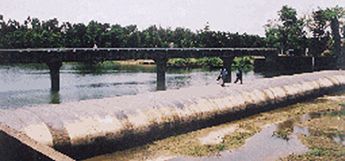
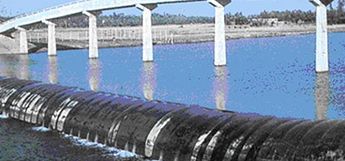
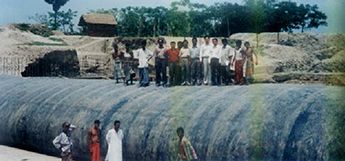
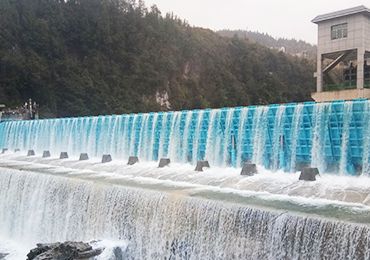
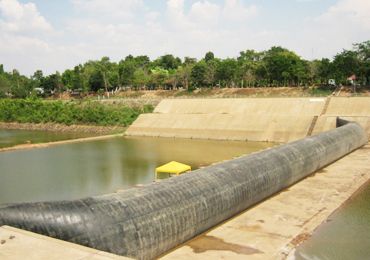
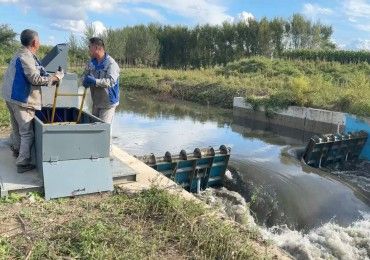
Inflatable Rubber Dams are constructed of high-quality, durable rubber materials. They are installed across waterways to control and regulate the flow of water. The inflatable flood barrier can be inflated and deflated as needed to control water levels, making it a highly adaptable solution for different water management scenarios. Rubber flood barrier can be divided into inflatable rubber dam and water filling rubber dam according to the filling and drainage methods.
L*H=353*4(m)
Applications: Water retaining, Farm irrigation.
Location: Sadar Upazila of Chapainawabganj, Bangladesh.
Primary applications: Water retaining, farm irrigation, fisheries support
Economic benefits: The under-construction rubber dam in the Mahananda river has been showingimmense prospects of boosting production ofagriculture and fisheries in Chapainawabganjdistrict. More than 7,500 hectares of land could be brought under irrigation. As a result additional 33,750 MT of food crops will be produced every year, worth around USD 17.00 million. As a whole, the scheme will facilitate boosting round the year surface water uses for irrigation purposes. It would also help to improve the environment there, a common concern of the area.
· Low and highly seasonal river levels during the dry season
· Heavy siltation requiring channel restoration
· Need for flexible water-level control to support irrigation and fisheries
· Balancing agricultural demand with environmental considerations
· Inflatable rubber dam installed to raise upstream water levels during dry seasons and provide controlled releases during wet periods
· Targeted dredging to restore channel depth, improve sediment management, and increase effective storage
· Integrated operation plan combining dam inflation schedules, irrigation demand forecasting, and water-distribution coordination
· This combined approach enhances surface-water use efficiency and reduces reliance on groundwater pumping
· Structure: Reinforced inflatable rubber membrane anchored to a concrete base, designed for flexible operation and reduced civil-work complexity
· Project dimension on record: LH = 3534 (m)
· Supporting works: dredging spoil placement, maintenance access structures, and pump interfaces for irrigation distribution
· Annual crop increase: approx. 33,750 MT
· Irrigation coverage: more than 7,500 hectares
· Economic uplift: estimated at roughly USD 17 million per year
· Improved local employment opportunities through enhanced irrigation, cropping intensity, and fisheries productivity
· Inclusion of fish-friendly operational rules during migratory seasons
· Sediment management strategy through periodic dredging
· Monitoring of groundwater recharge effects to maintain balanced water distribution
· Adaptive operation schedules to minimize ecological disruption
· Irrigated area expansion (ha)
· Annual food-crop production increase (MT)
· Extended water-availability duration during dry months
· Improved fisheries production and local income indicators
· Combining dredging + inflatable rubber dam yields higher hydrological efficiency than either method alone
· Early involvement of farmers and local communities improves operational adoption
· Sediment, groundwater, and fisheries monitoring should be integrated into the design phase rather than implemented as a later retrofit
· Adaptive operation frameworks ensure long-term performance and environmental resilience