News
Low head radial gates play a critical role in modern hydraulic engineering systems where accurate water regulation, flood control, irrigation management, and hydropower optimization are required. Commonly referred to as Tainter gates, radial gates are among the most widely used spillway gate solutions in dams, barrages, diversion weirs, and river regulation structures around the world. Their popularity comes from their structural efficiency, operational reliability, and ability to manage large water discharges with relatively low operating force. In low head applications, these gates become even more valuable because they provide efficient water control while minimizing civil construction complexity and operational costs. Engineers and water management authorities continue to choose low head radial gates for projects involving reservoirs, navigation channels, irrigation systems, flood mitigation structures, and small hydropower developments because of their adaptability and long service life.
A low head radial gate is generally installed where the difference in water level between the upstream and downstream sides is relatively small. Unlike high head spillway gates designed for massive reservoirs and deep hydraulic pressure conditions, low head radial gates are optimized for moderate hydraulic loads while maintaining excellent discharge control. The curved gate leaf transfers hydrostatic forces through radial arms to trunnion bearings, which significantly reduces the lifting force required during operation. This efficient load distribution is one of the main reasons radial gates are considered economical and mechanically effective in water infrastructure projects.
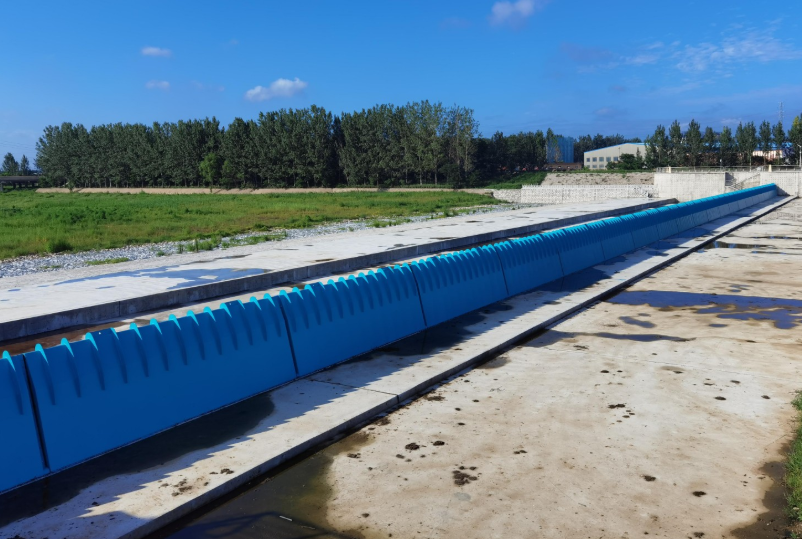
The operating principle of a radial gate is relatively simple but highly effective. The gate consists of a curved steel skin plate supported by radial arms connected to trunnions mounted on the side piers. When the gate rotates upward around the trunnion axis, water flows beneath the gate opening. Since the hydrostatic pressure acts through the center of curvature toward the trunnion, the hoisting equipment mainly lifts the weight of the gate itself instead of resisting the entire water load.
This mechanical advantage reduces energy consumption and allows the use of smaller hoisting systems compared with vertical lift gates. Practical engineering studies show that radial gates are among the most reliable and efficient spillway gate systems used in dam infrastructure globally.
One of the primary uses of low head radial gates is flood control. In rivers and reservoirs with fluctuating water levels, these gates regulate discharge rates and help maintain safe upstream storage conditions. During heavy rainfall or flood events, the gates can be gradually opened to release excess water while preventing overtopping of dams and embankments.
Their smooth operation and precise flow control make them highly suitable for flood management systems. Many modern spillway designs incorporate low head radial gates because they allow operators to react quickly to changing hydraulic conditions while maintaining structural safety.
Low head radial gates are also extensively used in irrigation projects. Irrigation canals and diversion barrages require accurate regulation of water delivery to agricultural fields. Radial gates allow operators to maintain stable upstream water levels and adjust downstream discharge according to seasonal irrigation demand.
Because these gates can operate efficiently under varying flow conditions, they help reduce water losses and improve distribution efficiency. In regions where water conservation is increasingly important, the ability of radial gates to provide controlled water release contributes directly to sustainable irrigation management.
Hydropower generation is another important application area for low head radial gates. In small and medium hydropower stations, maintaining consistent upstream headwater elevation is essential for maximizing turbine efficiency and energy output.
Radial gates help operators regulate reservoir levels and optimize water discharge into power intake systems. Their low operating force and reliable sealing performance make them suitable for continuous operation in hydropower environments. Some hydroelectric facilities also use radial gates as emergency spillway gates to safely release floodwater while protecting the powerhouse and dam structure.
Navigation structures and river regulation systems frequently use low head radial gates as well. In inland waterways and navigation dams, maintaining adequate water depth for vessels is essential for safe transportation.
Radial gates provide flexible water level control that supports navigation while allowing floodwater discharge during high flow periods. Their relatively compact structural arrangement and absence of large overhead support systems make them advantageous in navigation channels where space and visibility are important considerations.
Another growing application of low head radial gates is in urban water management and environmental restoration projects. Cities increasingly use controlled water retention systems to improve waterfront aesthetics, stabilize river levels, and create recreational areas.
Radial gates can maintain attractive urban water bodies while still providing reliable flood protection during storm events. In many modern urban hydraulic projects, engineers prefer radial gates because of their clean appearance, smooth operation, and ability to integrate into architectural landscapes.