News
A river may provide abundant water for only a few months each year, while industrial, agricultural, and municipal operations require a reliable supply throughout the entire year. Bridging this gap between water availability and actual demand is becoming increasingly important. Instead of relying only on large concrete structures, more projects are turning to rubber dams for water storage — inflatable barriers that retain river water when needed and flatten onto their foundations when water control is no longer required.
With more than 4,500 inflatable rubber dams operating worldwide, this technology is no longer an experimental concept. It has become a proven, reliable, and cost-effective solution that is particularly well suited to the water management challenges of Indian rivers.
A rubber dam is a flexible hydraulic structure designed to perform the functions of a weir, barrage, or check dam while offering greater adaptability. It consists of an elliptical bladder made from multiple layers of vulcanized high-strength EPDM rubber reinforced with nylon fabric. The structure is securely anchored to a concrete foundation across the riverbed using GFRP clamping plates and galvanized steel bolts.
When filled with air, the rubber bladder rises to form a watertight barrier that controls river flow and stores water upstream. When deflated, it collapses flat onto the foundation, allowing the river to continue flowing with minimal obstruction.
This ability to switch between active and inactive states represents the core advantage of rubber dam technology. Traditional gates rely on steel structures, lifting systems, and mechanical components to control water levels. In contrast, an inflatable rubber dam uses a simpler approach — temporarily occupying the riverbed only when water storage or flow regulation is required. With fewer mechanical parts, no rust-prone lifting systems, and no large gate structures that may become difficult to operate during flood conditions, rubber dams provide a reliable alternative for modern river management.
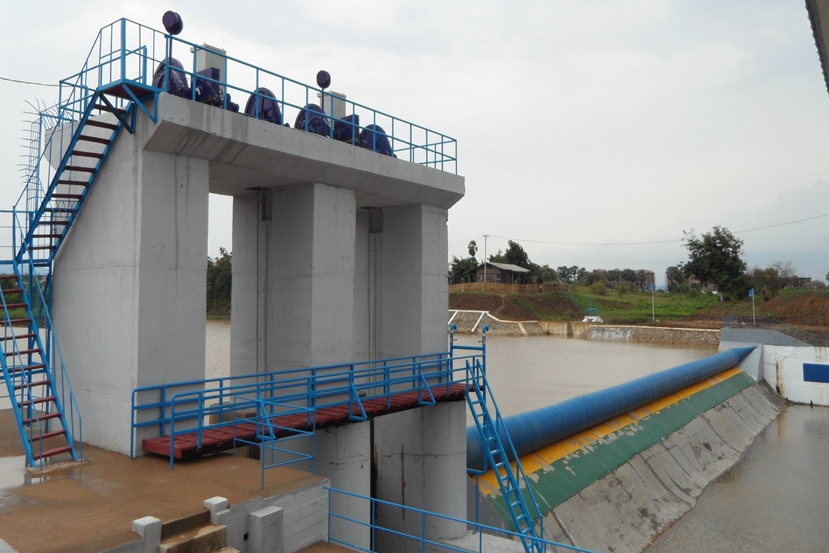
The operating principle of a rubber dam is simple yet highly effective. Low-power blowers, which can even be powered by solar energy, pump air into the bladder through integrated nozzles and piping systems. The internal air pressure provides the structural strength needed to support the dam, while water pressure is transferred through the reinforced rubber body and distributed to the anchored foundation. Deflation is just as efficient, allowing the dam to quickly return to a flat position when water release is required.
Three operating states are particularly important for water management:
· Inflated: The rubber dam functions as a weir, raising and storing upstream water for applications such as water storage, flow diversion, or increasing hydraulic head.
· Partially inflated: Operators can precisely adjust the water level and regulate downstream discharge according to changing water management requirements.
· Deflated: The dam lies flat against the foundation, allowing flood flows to pass with minimal upstream water level rise while also helping flush accumulated sediment naturally.
Modern rubber dam systems can be integrated with SCADA (Supervisory Control and Data Acquisition) technology, using water level and pressure sensors to provide real-time monitoring and automated control. By setting predefined operating parameters, the system can automatically adjust inflation and deflation levels, bringing a higher level of intelligence and efficiency to modern hydraulic engineering.
Rubber dams generally require significantly lower investment compared with equivalent gated structures, both in initial construction costs and long-term operation expenses. They eliminate the need for large gantry cranes, complex hoisting systems, regular painting, and corrosion protection measures. Maintenance is largely limited to routine inspections of the durable rubber body and related components.
Once the concrete foundation raft is completed, the rubber bladder can typically be installed and commissioned within approximately two weeks without the need for heavy installation equipment. For businesses where project delays directly affect operating costs and revenue, this shorter construction timeline can provide a major advantage.
The ability to deflate provides an inherent safety advantage. Unlike mechanical gates that may experience operational failures or become stuck during extreme conditions, a rubber dam can automatically or manually lower to allow floodwater to pass. When flattened, it allows the river to follow its natural flow path, reducing stress on the structure and protecting downstream areas. The lowered position also helps flush accumulated sediment and reduce pond siltation.
Inflation pressure directly affects the height of the stored water level, allowing operators to accurately control water retention, elevation, and discharge. This precise adjustment capability is valuable for irrigation management, hydropower optimization, and environmental flow requirements. Compared with fixed concrete structures or slower mechanical gates, rubber dams provide faster and more flexible water control.
Rubber dams support more environmentally responsible river management by maintaining a more natural river profile when deflated, allowing fish passage and facilitating environmental flow releases. These benefits are increasingly important for projects requiring environmental approvals. With low energy consumption and the option for solar-powered operation, rubber dams are also suitable for remote locations with limited infrastructure.
Rubber dams are versatile hydraulic solutions that can support a wide range of water management applications, from agriculture and energy generation to urban development and environmental improvement.
· Irrigation and agriculture: Rubber dams help capture and store pre- and post-monsoon river flows, allowing controlled water release throughout the rabi season. This reduces water wastage and helps maintain stable water availability across agricultural command areas.
· Hydropower: As diversion structures for low-head hydropower plants, rubber dams help maintain a consistent water supply for turbines while providing flexible control over hydraulic head when required.
· Groundwater recharge: By creating temporary ponded river sections, rubber dams increase water retention time and support natural infiltration into aquifers, providing an effective solution for water conservation in areas facing groundwater depletion.
· Urban and industrial water supply: Rubber dams create reliable intake pools for municipalities, mining operations, and industrial facilities that require stable water sources for daily operations.
· Reservoir capacity enhancement: Installed on existing spillways, rubber dams can increase effective storage capacity without the need for additional land acquisition or major new construction.
· River rejuvenation: Rubber dams can support the development of riverfront lakes and recreational water bodies, improving local landscapes while increasing value for tourism, public spaces, and surrounding real estate.
Water management challenges are becoming increasingly complex as demand continues to grow and climate conditions become less predictable. Rubber dams provide a practical, flexible, and cost-effective solution by allowing rivers to be controlled when needed while preserving their natural flow during normal conditions.
Compared with traditional steel gates and concrete structures, rubber dams offer faster installation, lower maintenance requirements, improved flood safety, and precise control over water storage and release. Their wide range of applications — from irrigation and hydropower to groundwater recharge, industrial water supply, and river restoration — makes them a valuable choice for modern hydraulic projects.
As water resources become more important for communities, agriculture, and industries, adopting smarter and more adaptable technologies is essential. Rubber dams represent a reliable approach to balancing water storage, flood protection, and environmental sustainability, helping ensure efficient water management for the future.